RCI Invited to Join GRESB Digital Transformation Seminar, Sharing Practical Insights on Smart and Sustainable Buildings
Helping Real Estate Assets Align with International ESG Benchmarks through Data Governance and Building Performance Verification
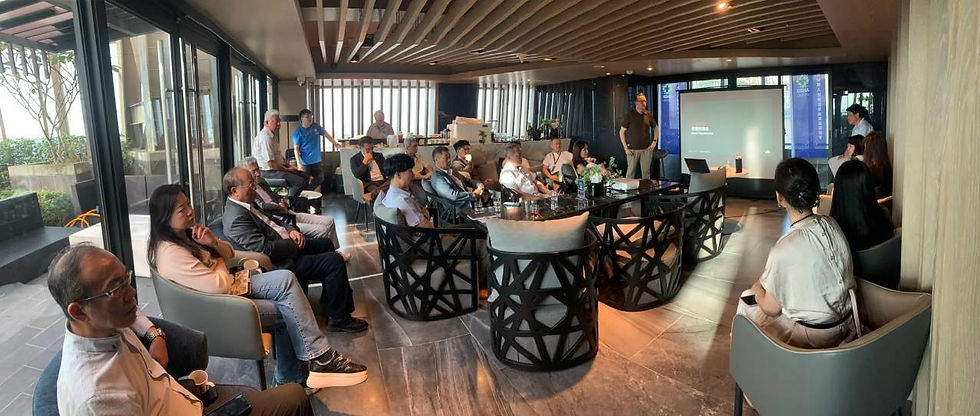
As global net-zero carbon goals, ESG disclosure, and green finance continue to advance rapidly, the real estate industry is undergoing a critical transformation—from viewing buildings as physical structures to managing them as measurable assets. RCI General Manager Shawn Jang was invited to attend the seminar “Smart Technology Empowering Sustainable Buildings: Key Digital Transformation Strategies for GRESB Adoption,” held on April 23, 2026 (Thursday), at the Taipei Nangang Exhibition Center, where he joined experts from smart buildings, sustainable materials, energy strategy, green finance, and international real estate sustainability assessment to discuss how GRESB and smart technologies can drive the sustainable advancement of the building industry.
The seminar focused on the role of GRESB (Global Real Estate Sustainability Benchmark) in real estate sustainability assessment, and explored how companies can enhance asset value through digital transformation while aligning with international ESG standards, from the perspectives of smart buildings, sustainable materials, data governance, and green finance.

RCI noted that the future competitiveness of sustainable buildings will not only come from energy-saving planning during the design phase, but will also depend on whether data can be continuously collected, managed, and verified during operations. By integrating AI, IoT, and energy management systems, smart buildings can turn energy use, indoor environmental quality, equipment efficiency, and user experience into trackable performance indicators—transforming buildings into dynamic systems that can be continuously optimized. As the original article also highlighted, smart buildings are not merely energy-saving tools, but platforms that integrate data and operational decision-making.
Shawn Jang, General Manager of RCI, stated: “GRESB is not just an assessment tool; it is an important framework for companies to examine the maturity of their asset management, data governance, and sustainability strategies. For real estate owners and operators, the real challenge is not obtaining a one-time certification, but establishing a management mechanism that can track, improve, and verify performance over the long term.”

From Certification to Operational Performance: Three Key Areas RCI Is Focusing On
1. Data governance is the foundation of smart and sustainable buildings
Energy, carbon emissions, indoor air quality, water resources, and equipment operation data within buildings must be effectively integrated in order to support ESG disclosure, GRESB assessment, and subsequent improvement decisions. Experts at the seminar also pointed out that the core of smart buildings lies not in the accumulation of hardware, but in the ability to integrate data across systems.
2. Life-cycle thinking will become a standard requirement for sustainable buildings
From design and material selection to construction, operations, and maintenance, the carbon emissions, energy efficiency, and health performance of a building throughout its entire life cycle will affect its long-term asset value. Sustainable materials and life-cycle management were also identified at the seminar as important directions for aligning with international trends.
3. Verifiable performance will influence asset value and financing conditions
When buildings are supported by complete data and verifiable sustainability performance, they are better positioned to respond to the ESG expectations of investors, tenants, and financial institutions. The original article also noted that buildings with complete data and sustainability performance have the potential to create a new business model of “data assets.”
RCI has long been committed to helping clients create buildings that are more environmentally friendly, healthier, smarter, and more efficient. Through integrated services covering ESG strategy, carbon strategy, green buildings, smart buildings, healthy buildings, building performance verification, and indoor environmental quality testing, RCI helps companies establish customized solutions aligned with global and regional sustainability standards—turning sustainability commitments into outcomes that can be measured, managed, and verified.
As global ESG disclosure, net-zero carbon reduction, and real estate asset management standards continue to rise, the value of buildings is no longer determined solely by design and hardware. Instead, it increasingly depends on the ability to continuously demonstrate measurable sustainability outcomes through data governance, operational management, and performance verification.
RCI will continue to provide integrated services across ESG strategy, carbon strategy, green buildings, smart buildings, healthy buildings, and building performance verification, helping companies create buildings that are more environmentally friendly, healthier, smarter, and more efficient—turning sustainability from a goal into a practice that can be managed and verified.